

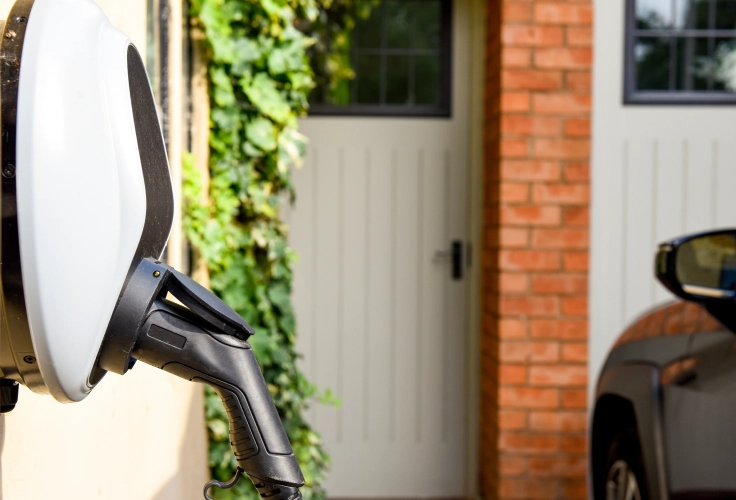
Online estimates for EV charger installation span such a wide range that they’re hard to plan around, and the final quote often lands higher than a quick search suggested. Most of that gap comes down to the home itself. A newer house with available electrical capacity and an attached garage is far less expensive to wire than an older one that needs panel work and a long conduit run to a detached garage.
Our team compiled data from ten independent sources plus EarlyBird Electric’s internal installation pricing to estimate the cost of a home EV charger installation in Minnesota as of August 2026. Sources include national installation-cost databases, a Minnesota installer pricing guide, a statewide electricity-rate estimate, and current federal, state, and municipal rebate programs published between March 2025 and August 2026. Reported figures were adjusted where noted to reflect Minnesota conditions, including local labor rates, home age and panel capacity, wiring distance to the panel, and state and local permit and inspection requirements. EarlyBird internal pricing reflects installations across its Twin Cities and Rochester service area and may differ from national averages.[1]
This guide breaks down where the money goes, what drives costs up, and how Minnesota homeowners can reduce the final bill.
Home EV Charger Installation Cost in 2026: At a Glance
| Scenario | Estimated Total Cost | What’s Typically Included |
|---|---|---|
| Simple install: charger near panel, adequate capacity | $800–$1,500 | Dedicated circuit, short wiring run, basic mounting, permit/inspection where required |
| Moderate install: longer wire run, no panel or service upgrade | $1,500–$2,800 | Extended wiring, conduit as needed, permit/inspection where required |
| Complex install: detached garage, long conduit run, or trenching | $2,800–$6,500+ | Additional routing, wall work or trenching, permit/inspection where required |
| Panel or service upgrade required | Add roughly $7,500–$9,000+ nationally; local project costs may run higher depending on complexity and utility requirements | New panel or service equipment, permits, utility coordination as applicable |
| Separate-meter or off-peak setup | Varies by utility and site | Metering equipment, utility coordination, and electrical work; eligibility and savings vary. Ask the utility whether a separate meter, panel work, or a specific charger is required before estimating savings |
| National standard-installation average | $1,700 | Qmerit’s reported 2026 average; confirm whether charger hardware and other upgrades are included in a quote |
Sources: EarlyBird Electric 2026; Qmerit 2026; EnergySage 2026. [1] [2] [3]
Important: Cost ranges are planning estimates, not fixed prices. Ask whether your quote includes the charger, permit fees, inspection, wall repairs, trenching, panel work, and utility-mandated metering.
What You’re Actually Paying For: The Cost Breakdown
Every home EV charger installation has three main cost components. Understanding each one helps you evaluate whether a quote is reasonable.
1. Charger Hardware ($300–$900)
Residential Level 2 chargers vary in price based on amperage, smart features, hardwired versus plug-in configuration, cable length, and brand. A basic 32-amp unit may cost a few hundred dollars, while feature-rich or higher-output models can approach $900. For many homeowners, a properly sized charger in the middle of that range offers enough power to recharge overnight.
Before buying, confirm the charger’s required circuit size, connector type, utility-program compatibility, and whether hardwiring is required for a rebate. Also confirm what equipment is included with your specific vehicle: many EVs can use a portable 120-volt charging cable, but not every new EV includes one.
2. Electrician Labor and Permits ($500–$1,200)
Labor is the largest variable in many installation quotes. Electrician rates, time on site, and the complexity of routing wire can change the total substantially. Qmerit reports permit costs that range from about $50 to $800 by jurisdiction, with an average of approximately $310. Minnesota fees vary by the responsible state or local authority and by project scope.[2]
In Minnesota, a new 240-volt EV charging circuit will require a permit and inspection. The applicable authority having jurisdiction may be the state or a local city or township, and the inspection process varies accordingly. A licensed contractor commonly coordinates this process, but homeowners should confirm the rules with the applicable authority before work begins.[4]
3. Materials: Conduit, Wire, and Breaker ($200–$500)
The materials that connect the charger to your electrical panel add up quickly, especially if the garage is far from the panel or walls are already finished. A longer wire run, conduit through drywall, or underground trenching to a detached garage can all push material and labor costs higher.
| Component | Low Estimate | High Estimate |
|---|---|---|
| Level 2 charger hardware | $500 | $900 |
| Electrician labor and permitting | $500 | $1,200 |
| Materials: conduit, wire, breaker | $350 | $900 |
| Typical straightforward project | $1,000 | $1,800+ |
Sources: Qmerit 2026; EnergySage 2026. [2] [3]
5 Factors That Move Your Installation Price the Most
Two jobs can look identical on the surface and still cost far apart. These five variables explain most of that difference.
1. Distance From the Charger to Your Electrical Panel
This is usually the biggest cost driver. The closer the charger is to your panel, the lower the installation cost. A charger mounted in an attached garage within a short run of the panel is often the most affordable setup. Each additional foot of wire adds materials and labor. Moving the charger to a detached garage can add $1,000–$1,500 or more, depending on routing, trenching, and local requirements.[3]
2. Your Electrical Panel’s Current Capacity
A Level 2 charger on a 50-amp circuit supplies up to 40 amps of continuous charging load. A home with 200-amp service and available electrical capacity may be able to support that circuit without a major upgrade, but open breaker slots alone are not enough. A licensed electrician should perform a load calculation to determine whether the existing service can safely support the added load.[3]
Older homes and homes with 100-amp service are more likely to need a capacity assessment, especially if they also use electric heat, air conditioning, electric water heating, or other large electrical loads. A service upgrade is not automatic: the right answer depends on the home’s load calculation and future electrification plans. A charger installed with load-shedding capability is another possible option. This equipment costs more, but can potentially help avoid needing to upgrade the electrical service.
There are several possible solutions if your panel is tight:
| Option | Typical Cost | When It May Help |
|---|---|---|
| Add a breaker or circuit component | Parts-only cost varies; labor, wiring, permit, and installation are additional | When there is adequate capacity and suitable panel space |
| Install a subpanel | $800–$1,500 | When the main panel is full, and extra breaker space is necessary |
| Upgrade the main service | $1,500–$4,000+ nationally | When the load calculation shows the existing service is insufficient |
Source: EnergySage 2026. [3]
3. Hardwired vs. Plug-In Installation
Hardwired chargers are permanently connected and can support higher charging output in compatible installations. Plug-in chargers use a 240-volt outlet, such as a NEMA 14-50, and are easier to take with you if you move. The installation-price difference is often modest, but it varies by circuit size, outlet quality, charger requirements, and local code requirements. Some utility rebates require a hardwired or connected charger, so check the program terms before choosing equipment.[3]
4. Permit and Inspection Requirements
Permit fees and inspection procedures vary by authority having jurisdiction. Your electrician should identify the relevant state or local permit process and include it in the quote. Before accepting a bid, ask whether the price includes permit fees, inspection coordination, and any required corrections.
5. Labor Rates in Your Area
Labor rates vary by market. Urban areas such as Minneapolis and St. Paul can have higher labor costs than some rural Minnesota communities, while rural jobs may face travel or scheduling premiums. Compare itemized quotes from qualified licensed electricians with EV-charger experience rather than choosing solely on the lowest price.
Level 1 vs. Level 2: What’s the Difference in Cost?
Many new EV buyers consider whether they need to install anything at all. A standard 120-volt outlet can be enough for some drivers with short daily mileage, while a dedicated Level 2 charger is more convenient for most households.
| Charger Type | Voltage | Typical Range Added Per Hour | Install Cost | Notes |
|---|---|---|---|---|
| Level 1: standard outlet | 120V | 3–5 miles | $0 if a suitable existing outlet is available. If an outlet is needed, costs range $500–$950 | Many EVs can use portable Level 1 charging equipment; confirm what is included with your vehicle and whether the outlet is in safe condition |
| Level 2: typical home charger, 40A or less | 240V | 20–30 miles | $1,200–$2,700 | Requires a dedicated circuit and appropriate permit/inspection process |
| Level 2: higher-output setup, 48A–90A | 240V | Up to 45+ miles in compatible vehicle and equipment setups | $1,800–$4,000+ | May require higher-capacity equipment, a hardwired connection, and a panel-capacity assessment |
Sources: EnergySage 2026; Tesla Mobile Connector product information. [3] [10]
Level 1 charging can take 40 hours or more to recharge many EVs. Level 2 charging can often bring that down to an overnight session, although actual charging time depends on battery size, the vehicle’s onboard charger, the circuit rating, and the vehicle’s starting state of charge.
Home EV Charger Installation Costs in Minnesota
Minnesota homeowners can see different pricing from national averages because local labor rates, home age, panel capacity, wiring distance, and the local permit authority all matter. According to EnergySage’s 2026 Qmerit-based data, the average installation cost excluding the charger unit is $2,592 in Minnesota, compared with a U.S. average of $2,442.[3] Qmerit’s $1,700 figure refers to a standard Level 2 installation average, while EnergySage’s state-level figure excludes charger hardware and may reflect a broader mix of installation conditions; the two figures are not like-for-like comparisons.
An attached-garage installation close to the panel is generally at the lower end of the range. A site visit and itemized estimate remain the best way to confirm your home’s cost.
Using ElectricChoice’s statewide estimate of 16.9 cents per kWh, a 60-kWh full charge is approximately $10.14 before charging losses or utility-plan differences. Actual charging costs and fuel savings vary with your EV, miles driven, winter efficiency, rate plan, gasoline prices, and charging location.[5]
Sources: EnergySage 2026; ElectricChoice 2026. [3] [5]
Minnesota Rebates and Rate Programs That Can Lower Your Cost
Utility programs can reduce upfront costs, but they change frequently and usually include equipment, meter, enrollment, inspection, rate-plan, service-area, or funding requirements. Confirm the program terms before purchasing equipment or scheduling work.
| Program | Current Value | Key Details |
|---|---|---|
| Federal Section 30C credit | Not available for property placed in service after June 30, 2026 | Under current IRS guidance, the credit is not allowed for property placed in service after June 30, 2026. Eligibility for earlier projects depends on applicable IRS rules and the taxpayer’s situation.[6] |
| Xcel Energy: qualifying Minnesota EV programs | Up to $500; income-qualified customers may be eligible for up to $1,200 | Up to $500 toward an eligible Level 2 charger and/or 240-volt wiring after enrollment in a qualifying EV program. Optimize Your Charge offers an annual $50 bill credit for eligible participants.[7] |
| Elk River Municipal Utilities | Up to $700 | Elk River’s current application lists technical requirements such as a 200-amp lever-bypass meter socket, passed inspection, and dedicated EV service. Confirm the current application before installation.[8] |
| City of Chaska | $250 per residential Level II charging port | The current 2026 application lists $250 per residential port; $500 is the commercial amount. Required permits and local-code compliance apply.[9] |
For an eligible Xcel customer, the current utility rebate may reduce the upfront project cost by up to $500. Verify the applicable program, availability of funds, meter requirements, and all enrollment steps before treating the incentive as part of your final budget.
Frequently Asked Questions
How long does a home EV charger installation take?
Most standard installs take part of a day. Complex setups, including long wire runs, detached garages, trenching, or panel upgrades, can take a full day or longer. A service upgrade may require a planned power interruption and utility coordination.
Do I need a permit to install an EV charger in Minnesota?
A new 240-volt EV charging circuit will commonly require a permit and inspection. In Minnesota, requirements are administered by the applicable state or local authority having jurisdiction. Your contractor can commonly coordinate the permit process, but confirm the responsible authority and what is included in your estimate.[4]
Does my electrical panel need to be upgraded?
Not necessarily. Homes with older or 100-amp service should receive a load calculation, but the need for an upgrade depends on the home’s actual electrical load, available capacity, circuit-routing requirements, and future plans. Open breaker slots do not by themselves prove that the service can support EV charging.[3]
Can I install a charger in a detached garage?
Yes. A detached-garage installation often costs more because of the longer wire run, trenching, or possible need for a separate service or subpanel. Some utilities offer special metering or off-peak rates, but availability, installation requirements, and actual savings vary by utility and charging schedule.
What is the federal tax credit for EV charger installation?
Under current IRS guidance, the Section 30C alternative fuel vehicle refueling property credit is not available for property placed in service after June 30, 2026. For earlier projects, eligibility depends on applicable IRS rules and the taxpayer’s situation; consult the relevant IRS instructions or a tax professional.[6]
Schedule Your Home EV Charger Installation with EarlyBird Electric
EarlyBird Electric installs Level 2 EV chargers for homeowners in the Twin Cities and Rochester, including Minneapolis and St. Paul. Our licensed electricians evaluate your electrical panel, confirm your home’s capacity, complete the installation according to applicable code requirements, and explain your options before work begins.
Ready to get your home EV charger installed?
Schedule an EV Charger Estimate with EarlyBird ElectricSources
- EarlyBird Electric, internal home EV charger installation pricing analysis (Twin Cities and Rochester, MN), 2026.
- Qmerit (Samuel Jackson), “The Ultimate Guide to Level 2 EV Charger Installation Costs”, March 18, 2026.
- EnergySage, “How Much Does an EV Charger Installation Cost?”, updated June 22, 2026.
- Minnesota Department of Labor and Industry, “Electrical Permits: Homeowners”, accessed August 11, 2026.
- ElectricChoice.com, “EV Charging Costs by State (2026)”, updated August 11, 2026.
- Internal Revenue Service, “FAQs for Modification of Section 30C Under Public Law 119-21”, accessed August 11, 2026.
- Xcel Energy, “Charger and Wiring Rebates” and “EV Charging Incentives”, accessed August 11, 2026.
- Elk River Municipal Utilities, “EV Charger Rebates”, accessed August 11, 2026.
- City of Chaska Electric Department, “2026 Electric Car Charger Rebate Application”, accessed August 11, 2026.
- Tesla, “Mobile Connector”, accessed August 11, 2026.